The Problem of Economic Leakage
Economic leakage is the tourism industry's dirty secret. It refers to the proportion of visitor spending that "leaks" out of the destination economy — flowing instead to foreign-owned hotel chains, international tour operators, imported food and beverage suppliers, and overseas booking platforms. Conservative estimates suggest that between 40% and 70% of all money spent by international tourists in developing world destinations leaves those destinations almost immediately.
The numbers are stark. A tourist who spends USD 3,000 on a "African safari experience" at a luxury lodge owned by a foreign company may contribute as little as USD 300–500 to the local economy. The rest flows to shareholders in London, Frankfurt or New York, to marketing agencies in Europe, to food and beverage suppliers in the capital city, and to a booking platform in San Francisco. The communities living adjacent to the national park — who bear the costs of living alongside wildlife, of restricted land access, of noise and light pollution from tourism vehicles — receive almost nothing.
Where Your Tourist Dollar Goes: A Typical Scenario
Foreign-Owned All-Inclusive Resort
Community-Based Eco-Lodge
Locally-Owned Guesthouse + Local Guides
The alternative model — community-based tourism, where local people own and operate tourism infrastructure, where guides are local, where food is sourced locally, and where profits are reinvested in community development — produces radically different outcomes. And it produces better travel experiences for visitors in the process.
What Community-Based Tourism Actually Means
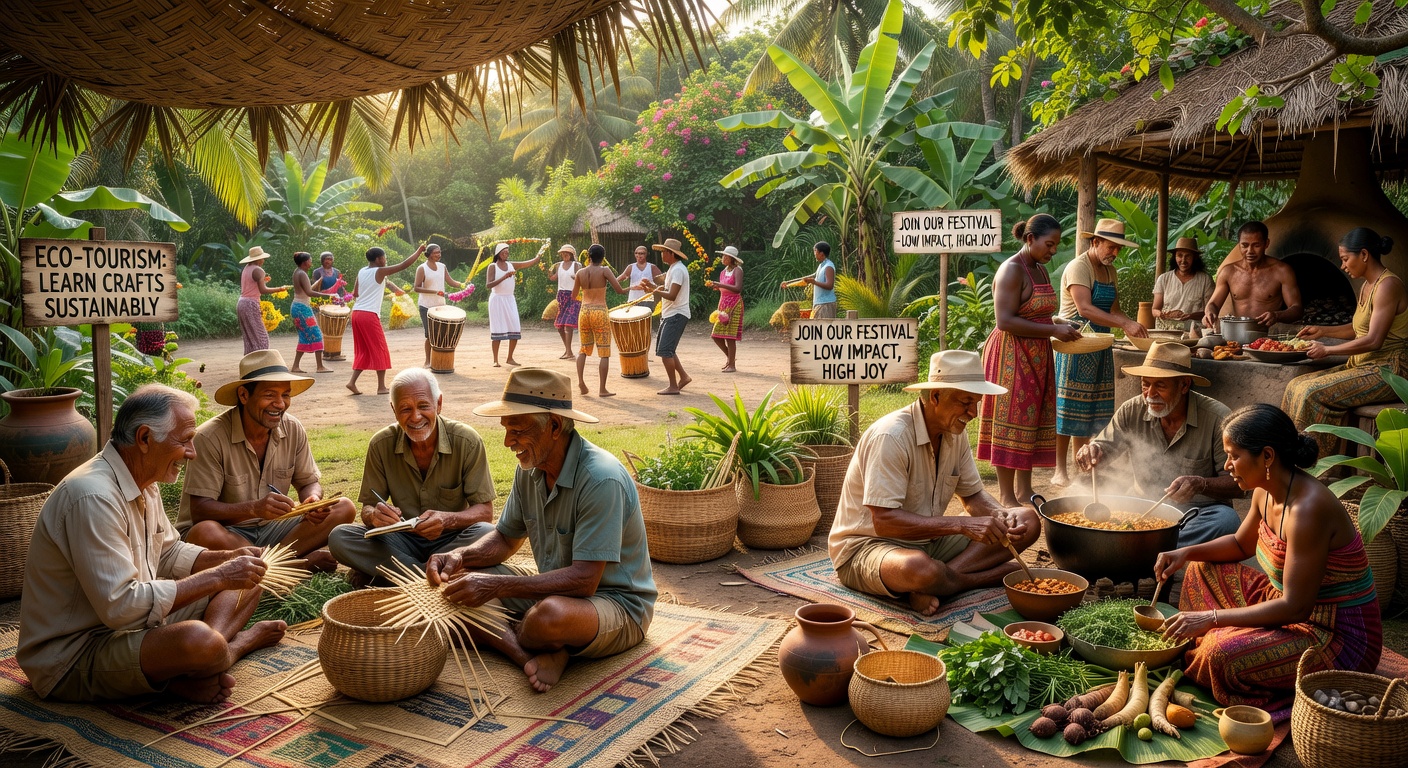
Community-based tourism (CBT) is not a specific product type — it is a set of structural conditions that determine who benefits from tourism activity. A CBT enterprise may be a jungle lodge, a home-stay network, a cultural tour company, a handicraft cooperative or a fishing village guesthouse. What distinguishes it from conventional tourism is ownership and governance: the enterprise is owned, managed and staffed primarily by the community it operates within, and profit distribution is democratically determined.
This structure has several practical consequences. Guides are genuinely local — they know the landscape, the wildlife, the history and the culture from lived experience, not from a manual. Food is sourced from local gardens, farms and fishing boats, keeping spending circulating in the local economy. Craft and artisan products are genuine, not manufactured imports. And the cultural exchange on offer is authentic rather than staged — a genuine encounter between visitor and community, rather than a performance for tourism consumption.
The Three Pillars of Genuine CBT
- Community ownership of infrastructure (majority stake held locally, not by external operators)
- Democratic profit distribution (community assembly or elected committee decides how profits are used)
- Local employment at all levels including management (not just frontline service roles)
Case Study 1: The Sani Lodge Community Enterprise, Ecuador
Sani Isla, Napo Province, Ecuador
Community-Owned Rainforest LodgeThe Sani community of the Kichwa people of the Napo Province in Ecuador's Amazon basin established their community lodge in 1998 after recognising that outside operators were extracting significant value from tourism in their ancestral territory without meaningful benefit to the community. The community voted to establish their own lodge on their territory — wholly owned by the community — and to manage it themselves.
The lodge now receives approximately 1,200 international visitors per year at a room rate competitive with comparable lodges in the region. The difference is what happens to that revenue: it flows through a community fund, governed by an elected assembly, which has used it to fund a community health clinic, a bilingual school (teaching in both Kichwa and Spanish), a women's artisan cooperative, and a reserve fund for emergency community needs.
The conservation outcomes have been equally remarkable. Sani community members, who now derive direct economic benefit from protecting the surrounding rainforest, actively patrol against illegal logging and poaching. The community has documented over 560 bird species and 100+ mammal species within the territory — evidence of ecosystem health that would be impossible without active local guardianship.
Case Study 2: The Mto wa Mbu Cultural Tourism Programme, Tanzania
Mto wa Mbu Village, Northern Tanzania
Cultural Tourism ProgrammeMto wa Mbu, sitting at the entrance to Lake Manyara National Park in northern Tanzania, is a genuinely extraordinary village: home to 42 distinct ethnic groups, multiple religious traditions, and a banana-based agricultural economy supplemented by artisan craft production. For decades, safari vehicles drove through the village on their way to the park without stopping — transferring nothing economically.
The SNV Netherlands Development Organisation partnered with the village in the early 2000s to develop a community tourism programme that kept tourism money in the village. The programme trained local guides from every ethnic group in the community, established a rotational booking system that distributed tourist visits equitably, and created a community fund that directs 10% of all tour fees to village infrastructure and education.
Today, over 180 guides operate from the village, offering experiences as diverse as traditional banana beer brewing, Iraqw traditional homestead tours, local market walks, and agricultural demonstrations. Average household income among participating families has increased by over 40% since the programme's full implementation. More significantly, the intangible cultural heritage of each ethnic group — dances, food traditions, craft techniques, oral histories — has been documented and actively preserved specifically because tourism has given it economic value.
The Fair Pay Question
One of the most persistent injustices in tourism economies is the suppression of wages for frontline tourism workers — guides, porters, drivers, cooks — despite the fact that these workers are often the primary reason visitors choose a particular operator over another. A guide's knowledge, language skills, natural history expertise and interpersonal gifts are the product being sold. They are rarely compensated accordingly.
The International Porter Protection Group has documented systematic underpayment of porters in trekking destinations from Nepal to Kilimanjaro. The GSTC (Global Sustainable Tourism Council) minimum wage standards for tourism workers are widely ignored by all but certified operators. And the proliferation of "budget" tour operators in competitive destinations is driven, in large part, by the suppression of guide wages rather than efficiency gains in other areas of operations.
As travellers, we have direct influence here. When comparing operators, the price difference between a budget operator and a responsible one is almost always accounted for by what each pays their staff. Choosing the cheaper operator is, in most cases, choosing to transfer money from a local guide to a tour company's margin. The cheapest option is never the most ethical one in tourism economies.
How to Ensure Fair Pay When You Travel
- Ask operators directly: "What percentage of the tour price goes to the guide?" A responsible operator will answer readily
- Choose operators who are members of the Fair Wage Network, GSTC-certified, or hold Travelife Sustainability accreditation
- Pay tips directly to individual workers, not through the company — and ask guides what a fair tip looks like in the local context
- Avoid "free walking tour" models where guides work solely for tips — this model structurally depresses wages
- Book directly with local operators where possible, cutting out intermediary platforms that take 20–30% commission
Cultural Preservation Through Tourism Revenue
The relationship between tourism and cultural preservation is complex and often paradoxical. Tourism can commodify culture, freeze it in a performative amber that serves visitor expectations rather than community needs. But it can also — when structured correctly — give endangered cultural practices economic value that makes their preservation genuinely rational from the community's perspective.
The most successful examples of tourism-funded cultural preservation share a common characteristic: the community controls the presentation of their own culture, decides what is shared and what remains private, and retains the economic benefit of sharing it. When an outside operator sells a "traditional dance performance" to tourists, the cultural value flows outward. When a community manages its own cultural tourism programme, the incentive structure reverses: preserving the language, the dance forms, the agricultural techniques and the oral histories becomes directly profitable, and communities that might otherwise have abandoned traditional practices in favour of more economically rewarding modern ones find reasons to maintain them.
What This Means for How You Travel
The practical implications for conscious travellers are clearer than they might appear:
- Book directly with community-owned operators wherever they exist — the money stays in the destination
- Stay in locally-owned accommodation: guesthouses, home-stays, community lodges — not international chains
- Eat at local restaurants that source ingredients locally, not hotel restaurants that import food
- Buy crafts directly from artisans at source, not from hotel gift shops or airport retailers
- Choose guides through community tourism associations rather than hotel recommendations (hotels typically take commission)
- Ask before you book: "Is this operator community-owned or managed?" and "What specific community development projects does your tourism revenue fund?"
The answers to those questions will tell you almost everything you need to know.
"Tourism is not inherently good or bad for communities. It is a resource allocation mechanism. How it allocates resources depends entirely on the structures we build around it — and the choices we make as travellers."
The three communities profiled in this article — Sani Isla in Ecuador, Mto wa Mbu in Tanzania, and the dozens of analogous programmes operating across Southeast Asia, the Pacific and Latin America — are proof that it is possible to do this differently. The resource exists. The will exists. What's needed now is travellers who are willing to seek out these models, support them with their spending, and resist the convenient fiction that the cheapest option is a neutral one.