
Understanding & Reducing Your Travel Carbon Footprint
Aviation accounts for 2–3% of global CO₂ emissions — and it's growing. Here's your complete guide to measuring, minimising, and offsetting your travel's climate impact.
Aviation accounts for 2–3% of global CO₂ emissions — and it's growing. Here's your complete guide to measuring, minimising, and offsetting your travel's climate impact.
The aviation sector currently contributes between 2 and 3 percent of global CO₂ emissions, but when you factor in non-CO₂ effects — contrails, water vapour, and nitrogen oxides at altitude — the total warming impact is estimated to be 2 to 4 times higher. And with air travel projected to double by 2040, the travel industry must transform. The good news: the choices you make as a traveller have real, measurable impact.
A travel carbon footprint is the total greenhouse gas emissions — measured in kilograms or tonnes of CO₂ equivalent — generated by your journey. This includes direct emissions from flights, trains, cars and ships, as well as indirect emissions from accommodation energy use, food production, and manufactured goods you consume along the way.
A return economy-class flight from London to New York emits approximately 1.1 tonnes of CO₂ per passenger. For context, the average global annual sustainable carbon budget is around 2.3 tonnes per person — meaning a single transatlantic flight can consume nearly half your yearly allowance.
Because aviation emissions occur in the upper atmosphere, their warming effect is 2–4× greater than if the same CO₂ were emitted at ground level. This "radiative forcing" factor means that flying's true climate cost is significantly higher than the raw CO₂ numbers suggest.

Use tools like ICAO's carbon calculator, Atmosfair, or MyClimate to quantify the emissions of your planned journey. You can't manage what you don't measure. A single economy flight from Tokyo to Los Angeles generates around 1.5 tonnes of CO₂ per passenger — knowing this number is step one.
Rail travel produces on average 80% less CO₂ per kilometre than flying. On routes under 1,000 km — London to Paris, Tokyo to Osaka, Amsterdam to Cologne — the train is often faster door-to-door once you factor in airport time. Europe's rail network, Japan's Shinkansen, and India's expanding high-speed routes make this increasingly practical.
Takeoff and landing are the most fuel-intensive phases of flight, so direct routes are dramatically more efficient than connecting flights. Economy class has a carbon footprint roughly 3× smaller than business class and 9× smaller than first class, because it allocates a smaller share of the aircraft's total emissions per passenger.
Carbon offsetting is imperfect — it doesn't undo emissions, it compensates for them — but high-quality offsets via certified programs do fund genuinely valuable projects. Look for schemes verified by Gold Standard, VCS (Verra), or the UN's CDM. Avoid cheap "reforestation" programs with no permanence guarantees.
Hotels account for roughly 1% of global CO₂ emissions. Choosing accommodation certified by Green Globe, EarthCheck, or national eco-labels ensures your stay is powered by renewables, water-efficient, and waste-minimal. Many eco-lodges are also net carbon positive through on-site forest protection.
Food accounts for 10–30% of a household's carbon footprint, and tourism food is no different. Choosing local, seasonal, and plant-based meals over imported meat dramatically reduces emissions. A beef-heavy meal produces up to 10× more CO₂ than an equivalent plant-based alternative.
The "slow travel" philosophy — spending more time in fewer places — is one of the most effective ways to reduce your carbon footprint. Instead of a 10-day trip to 6 countries involving multiple flights, one month in a single region by land produces a fraction of the emissions while generating a far deeper experience.
Once at your destination, choose metro systems, buses, electric tuk-tuks, bicycles, or walking over petrol taxis and rental cars. If you need a car, EV rental is increasingly available in major eco-destinations. In cities like Amsterdam, Copenhagen, and Singapore, sustainable ground transport is already the default.
Every kilogram of luggage increases fuel consumption. Airlines burn approximately 0.03 litres of fuel per kg per 100 km. On a 10,000 km flight, a 20 kg bag is responsible for around 60 litres of additional fuel burned. Packing light — using a carry-on only — is a simple, impactful choice.
Individual action matters, but systemic change matters more. Support airlines investing in sustainable aviation fuel, advocate for carbon pricing in your home country, and share your low-carbon travel stories on social media. Visible social proof that sustainable travel is enjoyable accelerates cultural change.
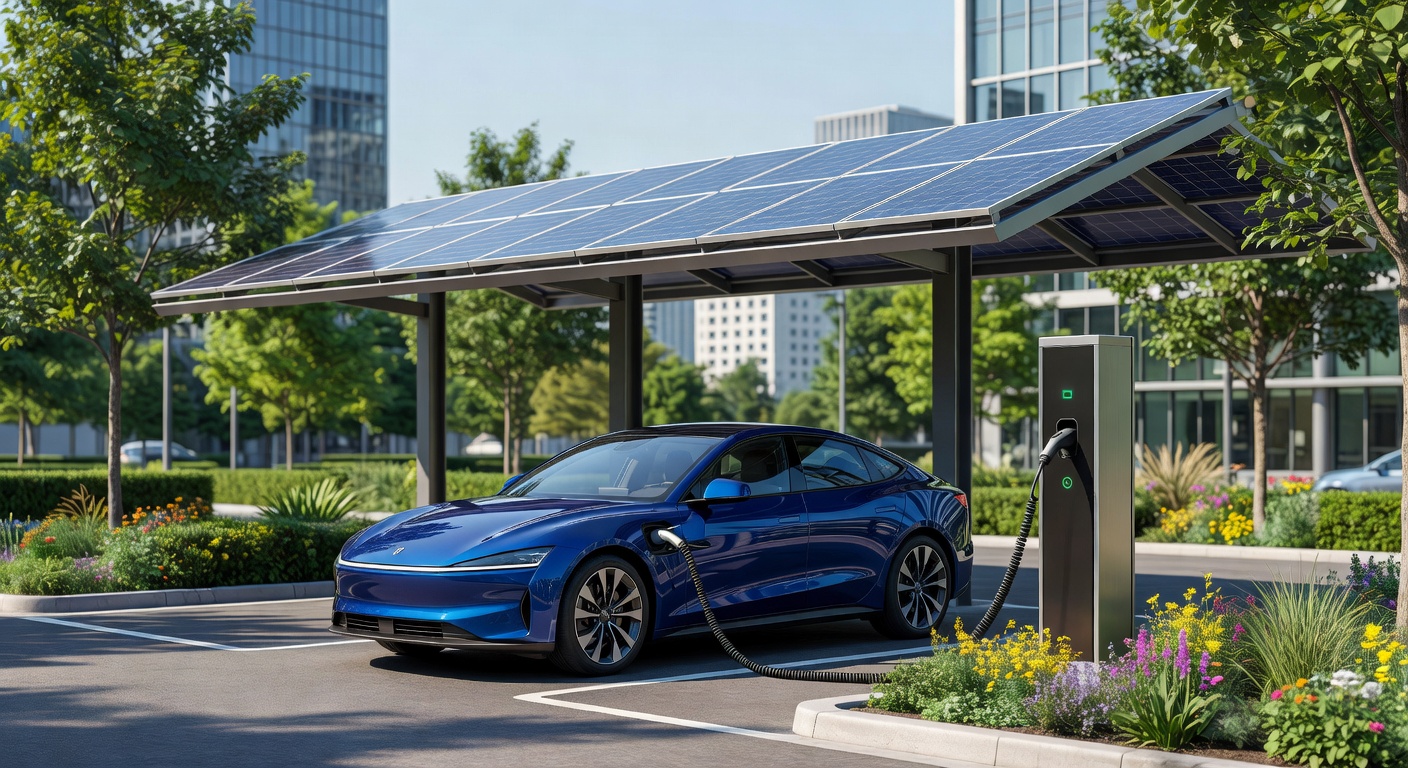
Ground transport accounts for a significant portion of travel emissions, particularly on multi-destination trips. Electric vehicles (EVs) powered by renewable energy can reduce transport emissions by up to 70% compared to petrol equivalents.
EV rental is now available in Iceland, Norway, New Zealand, Costa Rica, and many major cities worldwide. Pair an electric rental with renewable-powered accommodation and you can travel almost carbon-neutrally on the ground.
An EV charged from a renewable grid emits approximately 0.05 kg CO₂ per km, versus 0.21 kg/km for a petrol car. Over a 500 km road trip, that's 105 kg of CO₂ saved — roughly equivalent to planting 5 trees.
Not all carbon offsets are created equal. These four organizations have rigorous verification standards and transparent project reporting.
Founded by WWF, Gold Standard is the most rigorous offset certification available. Projects must deliver verified emissions reductions AND measurable sustainable development benefits for local communities. Costs are typically $10–25 per tonne CO₂.
The Verified Carbon Standard is the world's most-used voluntary carbon offset program, with over 1,700 certified projects globally. Projects range from REDD+ forest protection to clean cookstove distribution and renewable energy installations.
A German non-profit specialising specifically in aviation offset projects, with a focus on renewable energy in developing countries. Their online calculator is one of the most accurate available and includes the non-CO₂ multiplier for aviation emissions.
A Swiss-based foundation offering certified offset projects and climate protection programs. Their portfolio includes solar energy in Kenya, efficient cooking stoves in Malawi, and biogas plants in Nepal — all with strong community co-benefits.
To limit warming to 1.5°C, each person on Earth has a carbon budget of approximately 2.3 tonnes of CO₂ per year. Here's how common travel choices compare:
Accommodation choices have a surprisingly large impact on your travel footprint. Green-certified hotels typically use 20–40% less energy than conventional equivalents, and many eco-lodges generate all their electricity from solar or micro-hydro systems.
When choosing where to stay, look for certifications like LEED, Green Key, EarthCheck, or BREEAM. These schemes audit energy efficiency, water use, waste management, and procurement of local and sustainable goods.
Explore Eco Accommodation Tips